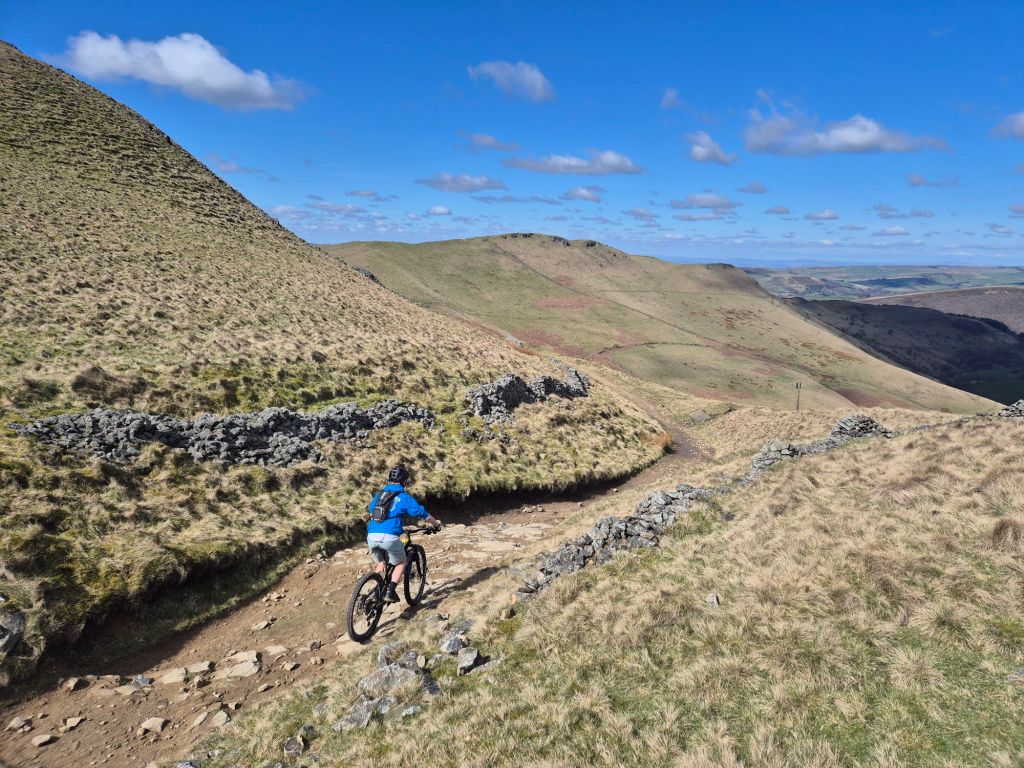
@KoftheP: It's simple. You ride, then send the trail conditions to us. We retweet and everyone gets a live update. We also do a little bit more these days
I’m not one for sitting about doing nothing. Me and beach holidays are not a good mix. So, with a sliver of spare time, I figured I’d launch a national mountain bike charity. As you do.
The Trail Pot – National Mountain Biking Development Fund has started. This is a charity which has been set up purely to improve mountain biking at the grassroots: the simplest of levels – the individuals and groups who are trying to make a difference at their local, local level.
I’ve been in this world for over a decade. Fighting, arguing, stressing over the cash we know can make a difference.
The Trail Pot aims to change all that, by having the money in place first, and then finding the projects.
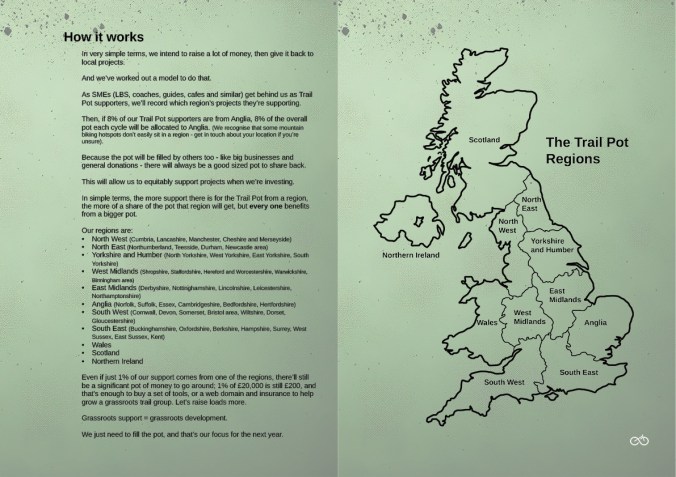
A nationwide collected pot of cash. Reinvested where the support comes from. Determined by local mountain biking communities.
We’ve drawn up a model which puts money back at the very base levels. We’re having conversations with people in the industry up and down the country (and wider) to get this thing working and make things better for mountain bikers nationwide.
But we need that money in.
It doesn’t need to come from you though – we’re not asking you to stump up. No. We’re asking you to ask your LBS, your local café, your online shop of choice, your favourite parts company, frame supplier, bike brand, mate(!) to support The Trail Pot, because if you do and they do, the future of mountain biking will be very bright. The great thing is that we’re not asking for big amounts either just micro-contributions. Their support is returned with a whole host of charitable supporting benefits but more importantly, a fertile and cultivated mountain biking community up and down the country.
I might be naïve, but the model is a win:win:win for everyone involved. Take a look at the website to find out how.
Yes I’m terrified! I’m a volunteer mountain biker who’s effectively set up something as time consuming and responsible as a start-up business to improve mountain biking nationwide down the line. I’ve got some great, experienced Trustees alongside me and a whole heap of belief that this can work, and work brilliantly.
Ultimately, I just want my kids’ mountain biking to be better. It’s a simple plan – just takes some cleverness to get there.
Take a look at thetrailpot.com for more info and give us a follow on Insta. Just look up thetrailpot.
Drawing deep breaths as we rode up the initial flanks of the hill, the mid-morning sun had filled the air with the intoxicating sweetness of cow-parsley.
In these initial few hundred metres from the car park, the fence lines, limestone dry stone walls and field edges were filled with the kaleidoscope of colour of countless wild-flowers that emerge once the last frosts of spring have determined it’s not worth the effort to challenge the sun anymore at this time of year.
Daisies, foxgloves and Forget-me-not peppered the dusty path beside us, becoming more sparse and widely spaced as we climbed higher, before they gave up altogether, preferring to stick to the more sheltered and warmer climes lower down the hill.
This was one of those trips that had been a long time in the preparation, as the many and varied pressures of family life had, over time, ensured that we couldn’t all easily nip away for an overnighter. Instead, the planning to get the many cogs aligned with mates from all over the north and Midlands was reminiscent of the meticulous machinations of a watchmaker. Just with the added need for flexible camping and a good pub nearby. But as each cog in the machine found its place, before long we were on the road and now on the trail, gently cranking up the limestone switchbacks towards our supposed summit; the climb ahead of us a zig zag of grey on a verdant green hill.
The climb, on a hot day, is unrelenting. And the hillside was at a gradient where we could see almost all of it, disappearing off in the distance….much higher above us. Before long we each fell into our own, stumbling rhythm. Each alone in our world, together on the ride.
But we were here, the sun was out, and we were riding our bikes towards the first gravelly, rocky switchback on a track which we could see got steeper as it meandered up the hill ahead of us. Some of us had had the pleasure of ‘riding’ it before and so knew the energy sapping relentlessness of the loose surface. But we were pushing those thoughts down, instead enjoying the long awaited, and unmatched pleasure of rolling a tyre over a hillside with our mates.
Riding further up, the track began to level off and the breathers we took were rewarded with the kind of a view you see on a chocolate box in the gift shop in the town below. Rooftops nestled in on the shore of the lake, steel blue mountains rising from the far bank, and beyond them paler summits and ridgelines could be seen, filtered by the haze of the mid-summer heat. At the halfway point on the climb to the summit, the view is obscured by a hillside and we kept riding through high-moorland grasses; meeting the occasional walker and rider heading back down the hill after an early morning start. The summit we were aiming for came into view and on its flanks, the grass had given way to rough patches of stone – slates and lime worn to the surface under the passage of hundreds of boots, tyres and hooves. For the unfit amongst us, the sight was a welcome one, presenting us with the inspiration to push on and muster the energy from the last stop’s handful of jelly babies, knowing that a trig point, an S-shaped sheepfold and a panoramic view awaited just a few hundred feet both up and ahead of us.
“bemoaning the fitness levels the joy of young families had imbued, we made the call not to bother with the summit”
kofthep
But, bemoaning the fitness levels the joy of young families had imbued, we made the call not to bother with the summit – we’d ridden it before after all – sacrificing the king of the world feeling being on top of a high peak, for maintaining energy levels on the promised exquisite descent. It was only a fleeting moment and we followed the horse-shoe hillside round to our long-planned destination.
It was a mouth-watering sight. Stretched out ahead of us, a ribbon of singletrack looked almost draped along the ridge before us – the path sticking mainly to the highline, and disappearing over a series of ever lower, jagged humps heading back to the lower hills.
Gathering together we determined the order we’d head down – the various factors of skill level, fitness, confidence…and stupidity… all playing a part in the running order. Then it was time for another handful of jelly babies, a final check on the important levers, lockouts and our legs before we paused for the obligatory selfie at the start of our descent. And that’s when we saw him.
The composition was perfect, six happy friends under the gaze of the slate grey mountain side. But there was one slight blemish on the photo – a mark which has only served to niggle me ever since; a blurry, white patch moving down the hill but snapped just as we all said ‘cheese’. And that was the tell tale dust cloud of a mountain biker having the descent of a lifetime.
Memories of childhood are always set in that perma-summer time. Hazy hues of pale brown and yellow and a languid recollection which seems to always render itself in slow motion. Mine aren’t rose-tinted. They’re scented with the smell of a burning stubble field; shaded with the dappled light of the oak and birch of the woods close to home; punctuated with the alarm call of a startled blackbird at dusk as I play with friends.
These images – postcards – of that time are imprinted on my mind, happily so. And they aren’t just some carefully curated collection of nostalgia. These sensations and memories are visceral, true things that happened that don’t so much hark back to a ‘happier’ time, but yet remind me of periods in my life where things were different, and the responsibilities of adulthood were not yet realised. One in particular often rises to the top of my thoughts when I’m out riding. It’s there for a fleeting moment, as memories are, but in that briefest of moments, entire days – weeks even – unfold in my mind and bring the warmth of that summer time flooding back, albeit briefly.
I can picture now the patchy hawthorn hedge over the ditch to my left. On the right, a barley field, dry, golden, rises away beyond my small horizon. The ground beneath my buckled shoed feet is hard – it is summer – and the baked indents of wet weather boots trip me up and make me stumble as they crumble under my small steps.
Behind me, no doubt calling me to take care, my grandfather – Grandad – walks with my older brother, as always in his usual brown trousers, shirt and suit jacket no matter the occasion. My brother inevitably matching me in a t-shirt and shorts, walking the familiar path down the gentle slope and over the lane to the reservoir where we spent so many hours playing under Grandad’s gaze. The small reservoir nestles into the landscape in almost a T shape, the elongated end formed naturally into the valley and the top of the T bounded by an earth wall, around which intriguing sluices and channels became fortresses, caves and trenches for young adventurous explorers. I can see the rough grey concrete, overgrown with dark black and white mosses, I can almost feel the knock on my head of a hard concrete bridge as I crouch beneath it.
But the memory that persists isn’t one based on the colour, or the light, or the landscape. It is one of sound, and a sound which when I hear it today acts as a key to unlock that treasure chest of sights, sounds and hours spent doing nothing.
The skylark.
On those summer days, walking that dusty path, I likely wouldn’t have even noticed the frantic trills and calls of this curious little bird which, now with hindsight, I know will have been happily bouncing round on the wind a short height above me, my brother and Grandad. But its call was indelibly imprinted into that memory – ready to resurface when the right connection was made.
And joyously, that connection is made time and time again as I ride the hills and trails of the Peak District, though I didn’t know it at first.
Though grimly named, Mount Famine, close to Hayfield is a picturesque and impressive landmark on the Pennine Bridleway and it was here many summers ago, where that memory was unlocked. Hearing the now familiar call, I asked my friend what bird it was.
“A skylark”.
And right then, for that moment again, miles away from the reservoir, years away from my Grandad, I was back there with him then, and he was right there with me now on that hill. And as fleetingly as the memory returned, it was gone, leaving behind just a warmth and happiness still accompanied by the playful sound of the bird high above us.
Riding through the moorland heather, excited skylarks will often join me, teasingly staying a few metres ahead, jumping up and chasing away down the path only to land and repeat the process as I bob and weave, fearing I’ll one day catch up.
Above the Snake Pass, beyond Crookhill and towards Hagg Farm, at the top of the aptly-named ‘Screaming Mile’, the sheep-mown grass slopes away from the dry stone wall and pine woodland. It’s a short blast of track connecting an up to an enjoyable down. But it’s also the home of the skylark.
As I stop by the side of the path, unclip my boots, step off the bike, sit and take off my helmet, there’s no shame felt in me interrupting my ride. As, high above me the skylark wheels and turns, all the while singing his song, I’m once again back on the path to the reservoir. It’s summer time, and the baked hills around me are bathed in pale browns and yellows. Behind me my Grandad walks with my older brother as we head towards the reservoir for another adventure in the sun.
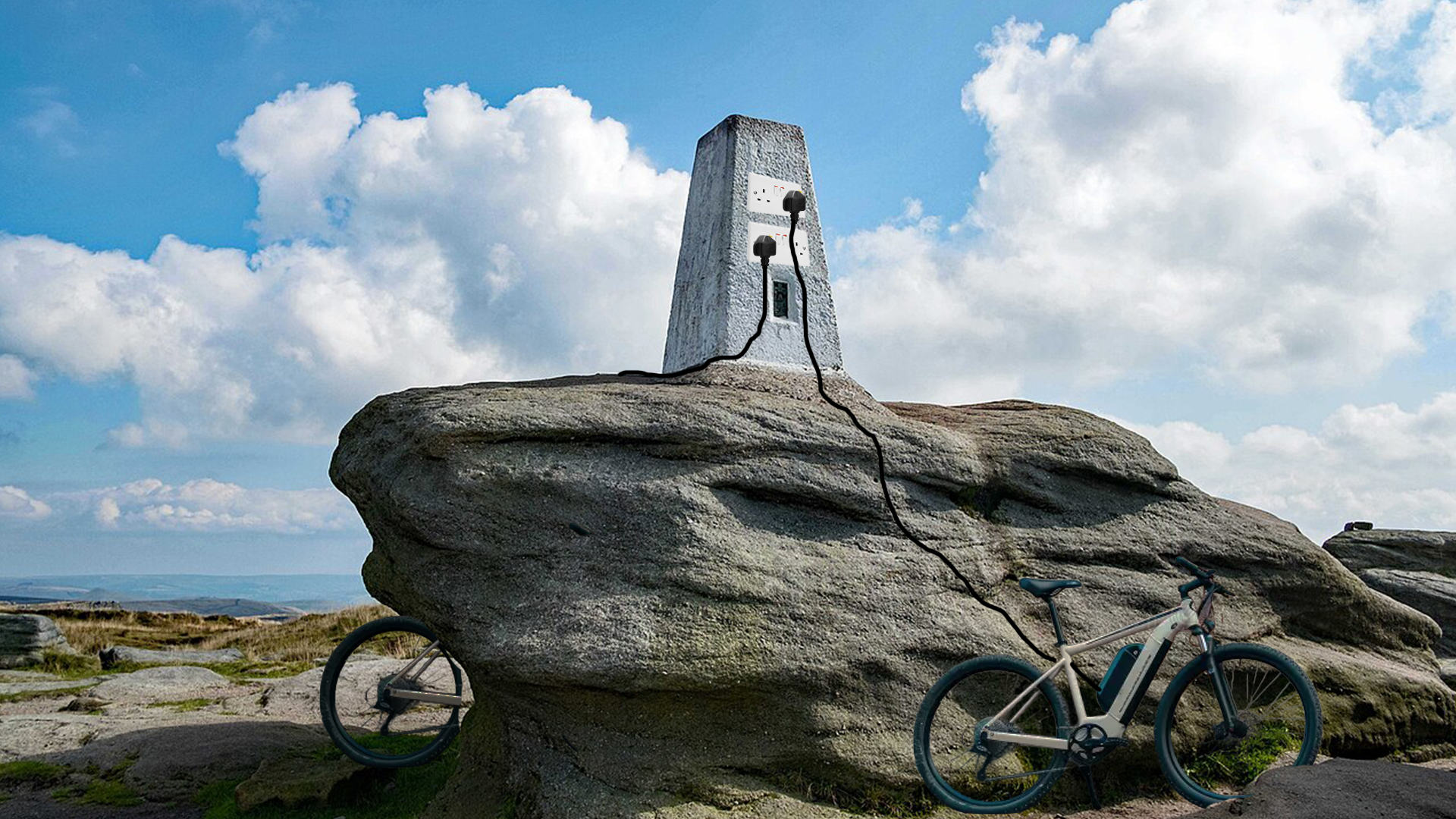
Trig points across the Peak District are to be upgraded to become e-bike charging points, in a wide ranging investment in infrastructure across the national park.
The pillars, conveniently positioned at points where riders typically stop for a rest anyway, will be connected via underground cables to the national grid, though during installation some overground cabling may be required.
“This marks the biggest change to the outdoors since Benny Rothman led 30,000 people on a mass trespass into the Duke of Devonshire’s billiard room,” says Trixie Day, e-nfrastructure e-coordinator for the ePeak ePulse eProject, which is leading the activity.
“The trig points are the perfect tool to bring charge to riders when they need it most, and our aim is not only to provide e-bike charging points, but also usb sockets for charging devices. The primary e-charging spots have been selected using the latest Artificial Intelligence tools developed by the labs at the Open University, making this the first E-AI-OU project in the peak.”
Subscriptions to the service will start at £7.99 per month.
For more information, contact april1EpulseEprojectEbygumEplugitin@sparkypops.com
The hills, valleys, crags and caves of the White Peak hold many secrets. Shadows move in dark corners, deep caves echo only to the sounds of water disappearing into the depths to emerge who knows where.
We’ve already spoken in these pages of the mysterious and terrifying Black Harry, the ghost of a highwayman who still patrols the lanes above Stoney Middleton – awaiting a late night wanderer, or a night rider tensely following a pool of light in front of them, fearful of looking behind scared they may see the spectral outlaw on their tail.
But emerging from Black Harry Gate, another terror may confront you.
Rising, steep over the valley, the towering cliffs of Middleton Dale form a deep and imposing valley. Beneath them, labyrinthine caves disappear dark underground. Though popular with climbers, it may not be one of these you see atop the tallest clifftop in the valley.
No, you might just spot the ghost of Hannah Baddeley.
It was 1762 and jilted by her lover William Barnsley at just 24 year old, Hannah ran to the top of the cliff distraught, and seeing no future without his love, she threw herself into the abyss. Fate had other plans, however, and a gust of wind caught Hannah’s long flowing dress, and she floated gently down to the valley below. She suffered only cuts and bruises, but died just two years later.
Her story does not end there though.
It is said that the ghostly form of Hannah can still be seen pining for her love at the top of the cliff, before taking her fateful leap once again.
So as you ride down the bridleway by Darlton Quarry dare yourself to look up, and should you see a young girl in a flowing dress standing silhouetted, spare a thought for the poor Hannah – destined to live an eternity in heartbreak.
Trial period on equal access begins in the Peak District
Outdoors groups have reacted with joy to the news that access to the rights of way network is going to be made equal from today. After years of campaigning for rights of access to be updated, today marks the first tentative steps in a period of testing for six months where all those using the paths in the national park will have the same rights.
“We’ve been looking forward to this day for years and years,” says Paul Myleg, Access Rights campaigner from the Foundation of Outdoors Liberation. “The equality we’ve campaigned for is finally here.”
From today, walkers, bicyclists, horse riders and unicyclists will be granted a blanket 11% access to the rights of way across the Peak, setting right years of injustice.
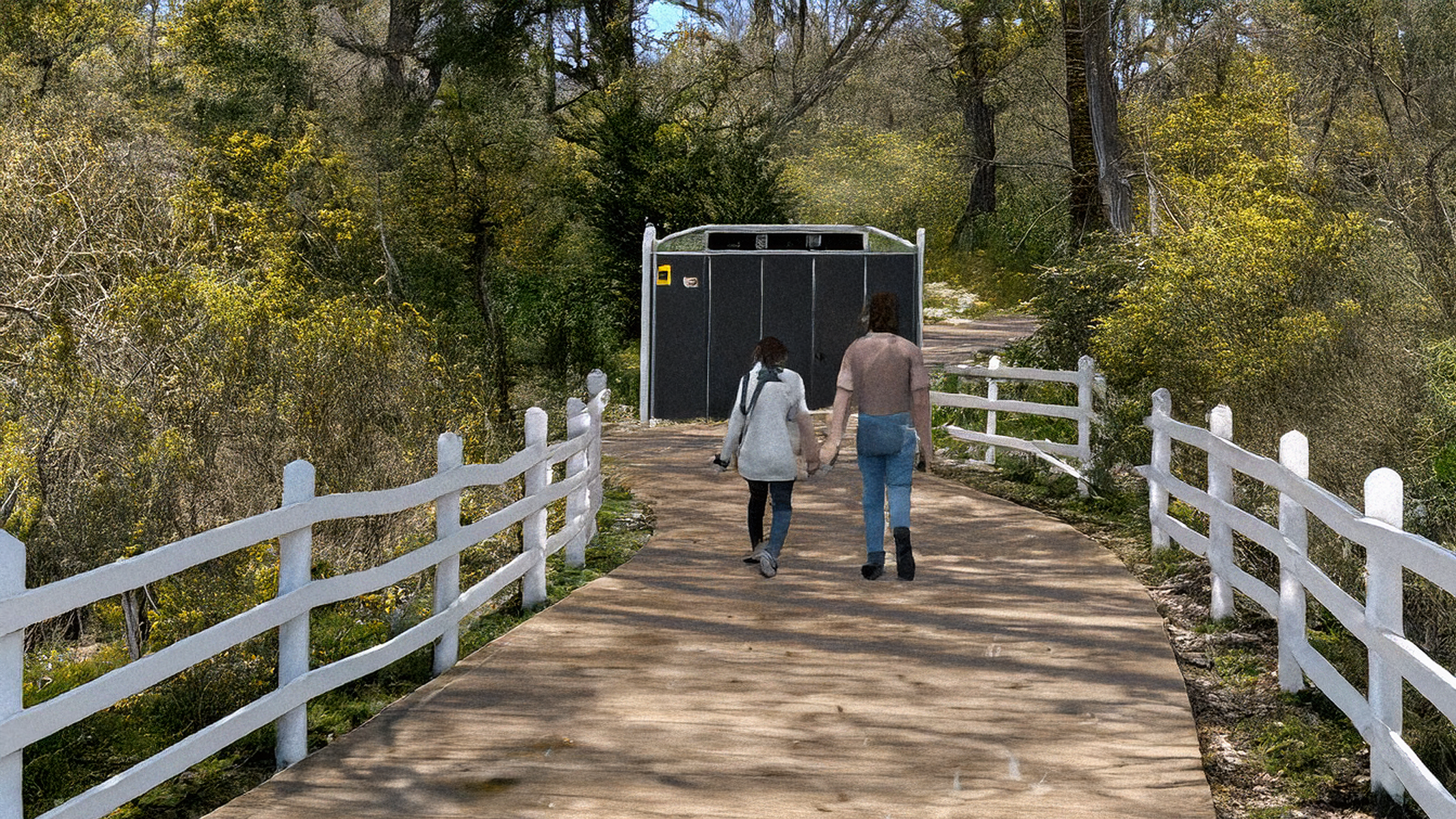
Heralding the change, Paul Theo Therone from Step-UP! Centres announced the ground breaking on a new “Walk Centre”, a dedicated walking facility featuring 3 miles of graded trails from family friendly ‘green’ grade pavements to more challenging ‘black’ trails featuring steps and puddles.
“We can’t wait to welcome walkers to our facility here in in the quarry,” says Paul. “We’ve started on the foundations today on what will be a amazing facility, removing the slurry and old metal work to begin on our car park – which will be just £8 a day using the latest finance tech.“
Step-UP! Peak District will feature boot cleaning facilities, and it’s hoped in the future to incorporate an uplift from partner company Gondola Solutions.
“We can’t wait to put our best foot forward,” adds Paul. “Here’s to the 11%!”
StepUP!’s green graded trails will be pay as you go so you can walk as little or as much as you like!
In my latest revisit of my digital archives, here’s a piece I wrote about the various indiscretions of outdoors folk, back in 2020. Funnily enough, my feelings are still pretty much here despite being five years down the line.
I’ve felt the need to press the reset button a few times in recent weeks. Whether it’s been the stress of lockdown with three kids and a full time job for eleventybillion weeks or just the general heightened sense of concern that seems to have taken hold globally, it’s sometimes felt like a constant white noise – in various different tones – of ‘stuff’ that’s made me want to step back, take my foot off the gas a bit and just try to put things in a bit more helpful balance.
And so I’ve been out riding my bike. And riding my bike as I used to a long time ago, before I got involved in organising stuff. Before I got involved in anything more than just going for a pedal. Back in the days where it was just a spin out for the sake of a spin out without the associated considerations of wanting to check a drain or see how a new feature was bedding in. Back to the time where I could ride up a path without getting frustrated about watching people stomp or ride the easy line and widen it. Back when I guess I was a bit more naive.
There’s some brilliant stuff emerging about how mountain bikers play a significantly contributing role to the places they ride. Not all ‘lycra louts’ – the vast majority are out there for a nice day, enjoying nature and wanting to enjoy it again next weekend. We don’t want widening trails – nirvana for a rider is a sinewy piece of singletrack. So it’s sad that the same old tropes about who we all collectively are constantly find themselves at the top of the social media news feeds simply because they engender the liveliest arguments and so get the traffic. Some of it is true of course, but the silent majority of riders, walkers, climbers, fell runners, boulderers, hang gliders, parascenders, dog walkers, cavers, photographers, bird watchers and bog snorkellers are just out in the Peak to have a nice time. Enjoy the space we have and get on with the people around us.
So why do we still have those petty frictions that nobody – anybody – wants? Why – when I’m on a rest ride – do I find myself bristling at the things that others are doing, that they themselves might not even recognise as ‘wrong’?
Is there some league table of ‘things you shouldn’t do’ out in the Peak?
Maybe we should hold a knockout competition to work out what’s the worst behaviour?
Round one: dog off a lead v. walker avoiding the slabs ‘cos it hurts their knees. Round two: riding a footpath that by all other measures is a farm track v. not closing a gate? Actually, it’d be a waste of time because we all know the shittiest behaviour is putting dog poo in a bag and hanging it off a tree – who the hell does that?
But what does that say for all those little indiscretions that to others are a declaration of war? I’m tired of the tribalism. I’m tired of the whataboutery and I’m tired of the finger pointing. Again, we’re all out there for a nice time. We all want it to be there when we go back next weekend.
But what have we got? Outdated access laws, entrenched views and everyone trying to point score over the others. To move things on we’ve all got to give a little. We’ve all got to try to see things from another perspective and maybe, just maybe, we’ll start to see some kind of progression.
Now, enough of this nonsense. Time for me to go and dust off my bog snorkel.
I once, very early on in my mountain biking life, took on a far longer ride than I was ready for, lugging a tent and sleeping bag in a massive back-pack. Spent at the end of what turned out to be a 40 mile trudge, I collapsed on a dark, flat piece of land and hunkered down for the night, into a restless and disturbed sleep.
Maybe it was my exhausted mind but throughout the night there were strange sounds and breathing outside my tent – the unmistakable sense of a presence prowling around on the other side of the canvas, centimetres from me sleeping alone in the pitch darkness of a remote hillside.
Winnats Pass is a mystical place with many dark and foreboding stories. As it spills open into Castleton, the tourists stream in and out of Peak Cavern – the Devil’ s Arse. But legend has it that Beelzebub himself lived deep in the cavern, emerging late at night to prowl the fields and hillsides of Castleton to wreak his evil intent upon lost, weary wanderers. Maybe Lucifer had found his next unsuspecting victim. Maybe not..
Further up the valley, on the slopes of Mam Tor, folklore tells of a particularly pesky boggart throwing stones and causing landslides. There’s a reason Odin Mine is off limits….maybe he had wandered a little further down the hill in search of mischief.
Or maybe I was hearing the heart-broken cries of Alan and Clara, the lovers murdered on their way to Peak Forest Chapel in the pass, their bones found ten years later by miners sinking an engine pit. Dragged off their horses by local brigands, Alan was brutally killed, and despite begging for her life, Clara soon followed.
But over time, Alan and Clara had their revenge, and their killers came to some particularly gruesome ends. One – Nicholas, fell from a precipice (or was he pushed..?) close to where the bones were buried and was killed. Thomas B hanged himself, haunted by the guilt. John B, walking nearby, was killed by a rock falling from a cliffside, and the remaining killer, James A, was haunted by the murders and went quite mad – confessing the whole sorry business on his death bed 20 years later.
Alan and Clara perhaps had their justice, or may still forever be destined to pace an eternal wedding march in the valley, never to be betrothed.
It was a restless night in the tent. But morning came.
I blinked awake in the early morning light and stepped out of my tent – scattering a gathered bunch of sheep – my late night visitors.
Stretching awake in just my pants, I took in the view ahead of me….and was frozen, petrified to the spot.
Before it opens, the bus tours of Speedwell Cavern queue up just beside the small, flat, grassy piece of land near the entrance. That morning it was a pensioners’ special. Early bird discount to see the beautiful sights of the Hope Valley and Castleton.
Or a knackered scrawny mountain biker stretching in his Y-fronts.
I’ve felt the need to press the reset button a few times in recent weeks. Whether it’s been the stress of lockdown with three kids and a full time job for eleventybillion weeks or just the general heightened sense of concern that seems to have taken hold globally, it’s sometimes felt like a constant white noise – in various different tones – of ‘stuff’ that’s made me want to step back, take my foot off the gas a bit and just try to put things in a bit more helpful balance.
And so I’ve been out riding my bike. And riding my bike as I used to a long time ago, before I got involved in organising stuff. Before I got involved in anything more than just going for a pedal. Back in the days where it was just a spin out for the sake of a spin out without the associated considerations of wanting to check a drain or see how a new feature was bedding in. Back to the time where I could ride up a path without getting frustrated about watching people stomp or ride the easy line and widen it.
Back when I guess I was a bit more naive.
There’s some brilliant stuff emerging about how mountain bikers play a significantly contributing role to the places they ride. Not all ‘lycra louts’ – the vast majority are out there for a nice day, enjoying nature and wanting to enjoy it again next weekend. We don’t want widening trails – nirvana for a rider is a sinewy piece of singletrack. So it’s sad that the same old tropes about who we all collectively are constantly find themselves at the top of the social media news feeds simply because they engender the liveliest arguments and so get the traffic. Some of it is true of course, but the silent majority of riders, walkers, climbers, fell runners, boulderers, hang gliders, parascenders, dog walkers, cavers, photographers, bird watchers and bog snorkellers are just out in the Peak to have a nice time. Enjoy the space we have and get on with the people around us.
So why do we still have those petty frictions that nobody – anybody – wants? Why – when I’m on a rest ride – do I find myself bristling at the things that others are doing, that they themselves might not even recognise as ‘wrong’. Is there some league table of ‘things you shouldn’t do’ out in the Peak? Maybe we should hold a knockout competition to work out what’s the worst behaviour? Round one: dog off a lead v. walker avoiding the slabs ‘cos it hurts their knees. Round two: riding a footpath that by all other measures is a farm track v. not closing a gate? Actually, it’d be a waste of time because we all know the shittiest behaviour is putting dog poo in a bag and hanging it off a tree – who the hell does that?
But what does that say for all those little indiscretions that to others are a declaration of war? I’m tired of the tribalism. I’m tired of the whataboutery and I’m tired of the finger pointing. Again, we’re all out there for a nice time. We all want it to be there when we go back next weekend.
But what have we got? Outdated access laws, entrenched views and everyone trying to point score over the others. To move things on we’ve all got to give a little. We’ve all got to try to see things from another perspective and maybe, just maybe, we’ll start to see some kind of progression.
Now, enough of this nonsense. Time for me to go and dust off my bog snorkel.
Seb Rogers, the editor of the brilliant Cranked magazine, gave me the encouragement to write from my heart about what mountain biking meant to me, and somehow even found the confidence in me to put those words into print alongside some of the best outdoors writers’ work out there. Since it’s closure, Seb kindly gave me the permission to share my columns here. Thanks Seb.
For a joyous few years in the not so distant past I had the honour of writing a column for Cranked Mountain Bike Magazine – one of the finest embodiments of the community of mountain biking put to print. Seb Rogers, the editor, gave me the encouragement to write from my heart about what mountain biking meant to me, and somehow even found the confidence in me to put those words into print alongside some of the best outdoors writers’ work out there. When Seb laid his editor’s pen down for the last time and closed the pages on the last ever Cranked, there was a palpable sense of grief in the mountain biking world for a jewel lost. Seb being Seb, his driving force was the celebration of mountain biking and the love of the community, and with that ethos he has been so wonderfully generous as to grant me the copyright to those few columns I had written for him, and allowed me to share them here. A true gent.
Over the coming weeks and months, I’ll run a series of the columns I wrote for Cranked, and hope you enjoy them as much as I enjoyed spending the time living my mountain biking memories once more, albeit on paper.
Anticipation
My tyres are red with yellow side walls. Grips: yellow, with red spots poking through their torn perforated rubber. Frame: red, with yellow decals. Up front: an unmistakable red and yellow heron badge. Saddle: moulded plastic, red again, with slots along its length for a little bit of flex.
I am 8 years old and sitting astride my Raleigh Burner, psyching myself up to do “the drop” 50 metres ahead of me where a small group stand, waiting. And a drop it was. For a four foot tall kid, anything higher than a plank on a couple of bricks was a big deal. And this was certainly bigger than that. Admittedly only about 10 inches bigger, but bigger all the same, and I was going to ride it.
A two foot drop from the grass verge on the side of the road to some old broken tarmac left over from when they were building the estate, it was an enticing sunken section. Amongst my friends, I was usually the idiot who had a go first. My dad remembers stopping me as I was mid 200 yard run up to the aforementioned plank and brick jump outside our house, dashing out just in time to block the ramp and prevent yet another trip to the local A&E department where I was rapidly becoming a regular.
But mum and dad weren’t there this time, and my friends were willing me on. In my mind they were awaiting my undoubted glory and confirmed brilliance. In theirs, they were clearly waiting for me to come a cropper. Hindsight is always 20:20.
And so off I set, milkbottle legs cranking the pedals towards the edge of the drop.
But now it’s 25 years later and instead of pushing my Raleigh Burner towards a small dip on my estate, I’m sitting at the top of Raise, with the summit of Helvellyn behind me to the south. It’s mid afternoon and we have spent the hot summer day riding the Lakeland fells to the highest summits in the country.
In all directions the landscape rolls away below us, and on the warm grey moonlike rocks we’re sitting waiting for four or five walkers to pass on their way to the summit so we can begin our descent. The path is steep, rocky, and loose. Switchbacks in it tease an uncertain ability to turn without a washout and in the distance we can see the enticing start of Sticks Pass, with its promise of sublime singletrack, natural jumps and a waterfall of cascading slate through an old quarry to take us back to the floor of the valley.
As the walkers pass they say their “hellos” and “thanks” and “you must be mads” and we all rise to our feet, step over our bikes, click camelbaks and cleats in place and begin the uncertain, but certainly sketchy descent down the hill in front of us.
But now it’s two years before and we’re shrouded in mist at the top of a Scottish stane. Perhaps the most well known. Certainly one of the most popular. After a long crank up through regiments of pine standing stock still, shrouded and silent atop a carpet of brown fallen needles, we sit together in an open gravel spot beside a picnic bench adorned with spider webs.
The path drops away from us, the first tabletop just an appetiser for its larger friends down the hill, one of which we can see, its top fading into the murk like the path the naïve teens are warned against going down in the movies just before the monster starts picking them off. Revealing previously unshown skills, Adey goes first with a small kick up before a much bigger jump from the lip of the second tabletop – and vanishes. His cheer and crunch of tyre landing on gravel let us know he’s fine and with raised eyebrows we dig deep to find similar untapped veins of expertise and throw ourselves into the unknown.
There is no feeling like a perfectly ridden berm; the recovery of a back wheel kicking out on loose stone; a drop timed so accurately that it almost feels as if you never left the trail. It’s why we ride. It’s why I ride. But to get to there, there’s a split second, a moment where the mind takes the snapshot that becomes the memory. Where you take – and hold – the breath before starting off. It’s that one moment that sticks.
It’s the anticipation.
The tipping point between waiting for, and doing. Where the build up becomes the pay off; and a hope of satisfaction and reward.
I don’t remember the drop on my Burner, any of the small jinks and moves needed on Sticks Pass, or how well I rode any of Glentress’s berms. But I can still feel the sensation of being set, ready to go, poised in that moment; a single breath held at a single point on a thousand different paths.
And there’ll be one on the next ride too no doubt.